TrailJustin
Member
- Joined
- Feb 21, 2025
- Messages
- 87
- Reaction score
- 5
- Tundra
- 2022 Limited DCLB TRD Offroad
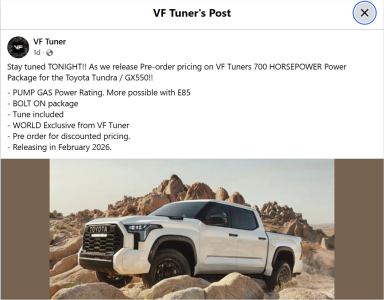
Find It Here: https://vftuner.com/products/vf-tuners-700-hp-package-3-5l-tundra-gx550
VF Tuner just dropped a pretty crazy package for the 2022+ Tundra, 2022+ Sequoia, 2022+ Lexus LX600 and LX700, and the 2022+ Lexus GX550. VF Tuner has been around for a long time, and I ran a variation of their tune on my Tacoma for over three years. That truck is still tuned to this day with the new owner.
With that being said, VF Tuner just dropped some big news for the Tundra platform.
This setup includes bolt on bigger turbos, a tune, calibrated wastegates, and is designed to run on 91 octane fuel. I’m a total nerd when it comes to this stuff and could go on forever about octane, turbo housings, ethanol vs pump gas, and all the details in between, but let me break down just how simple this actually is.
What You Need To Know:
- Bigger turbos / tuned turbo housings produce more boost faster and efficiently.
- The tune changes fuel trims to keep a proper air to fuel ratio making more power.
- 91 Octane fuel is needed because there is more air in the cylinder so it is under higher compression.
- 100% this will void your factory warranty.
- The large amount of sensors in modern vehicles make this rather safe and reliable to do.
- 700+ HP possible does not mean 100% reliable. (Will Touch on this in another Post).
Pros To This Kit:
- VF Tuner is a very trust worthy vendor in this field.
- Turbo housing are new manufactured housings from Japan. Not grinded or modified cores.
- No Cores are required you are getting a complete kit.
- Tested on their shop Tundra for "thousands of miles".
There is a big elephant in the room when it comes to motor reliability on these trucks, especially with the known reports of failures when the engine is under heavier loads. With that being said, I have also seen desert running Tundras being pushed hard, off the limiter, through the desert without any issues at all. At the end of the day, an engine is a mechanical thing. If it is running correctly, chances are it will continue to run correctly. And if something does fail, mechanical parts can be repaired.
In this kit, it says that 700+ HP is possible with additional aftermarket parts. What people need to understand, especially coming from someone who has helped build higher horsepower boosted cars in the past, is that just because a kit is capable of 650–700 HP does not mean it is running that power level all the time. More than likely, you could have this kit installed and tuned for 650 HP, but on a normal basis you would run a much lower power tune. With the push of a few buttons or plugging in a laptop, you would keep it closer to 400 HP for daily driving. Driving around on a 700 HP tune all the time is not very practical or comfortable, and it usually requires a very specific driving style.
To follow that up, the parts listed on the website appear to be high quality, and this looks like a solid way to gain horsepower while keeping the engine bay relatively stock looking. When it comes to builds like this, I also look at the price to horsepower ratio. How much power you gain for the money you are spending. For around $5,000, you are gaining roughly 300 HP, which is actually a pretty solid ratio. For comparison, on my Tacoma, a Magnuson supercharger kit costs around $8,000 and only adds about 100 HP. Modifying trucks that are already boosted is much easier than boosting a naturally aspirated platform from scratch.
All that to say, I am excited to see a few things happen here. First, I want to see how the early adopters do and hope they share their experiences publicly. Second, I am interested to see what kind of competition this creates in the space, because when companies compete for business, things usually get better for the consumer. And lastly, I am always curious to see what the Facebook warriors have to say, because there seems to be no shortage of them in the Tundra world.